Happy Wicked Week!
Are YOU a GOOD witch or a BAD witch?

It’s a monumental occasion… Wicked: For Good is here.
To know me is to know that Wicked means a lot to me. It was the first play I had ever seen at such a young age. I want to guess I was 9… perhaps 8… but maybe 7 or 10 as well. I was one of the numbers. It changed my life… who’s to say if I’ve been changed for the better, for real. I got my tickets for this film weeks in advance, and without having seen it once, I’m already contemplating making more plans just to see it again. They’re going to have to drag me out of the cinema.
For context, I was never the greatest Wizard of Oz enthusiast beforehand. I had seen it because… classics are classics, my parents loved it, as well as my grandparents. It kind of just always existed for me, but not as something I have an overwhelming fondness towards. I didn’t have a bad childhood, but it was a childhood with intense trauma, so nostalgia is a bit of a tightrope for me. I have a lot of memories blocked out from the late 2000s and early 2010s. Perhaps my Wicked love is tied to that, in a sense. It became a source of comfort and warmth in an era that otherwise has such turbulence associated with it. Most films in the The Wizard of Oz universe serve as a coming-of-age story. Finding your way back to a place of comfort and love but having to confront the unknown in the process. This applies to The Wizard of Oz, The Wiz, The Muppet’s Wizard of Oz, yet also Wicked. They don’t operate in the same framework, but they do operate in a similar throughline.
They all feature that similar journey. Having to jump into a world that’s unknown to reach your full power.
In preparation for Wicked: For Good, I’ve been obsessively consuming all things Wicked. The Original Broadway soundtrack, the first film soundtrack, the One Wonderful Night concert that’s streaming on Peacock now. I’m also reminiscing on the classic: The Wiz starring Diana Ross, and of course the original 1939 film that completely changed cinema. No, I haven’t read any of the books. I should reconcile that one day… not today.
I have followed the rumored film productions of Wicked since I was maybe 12. It got to the point where I had given up the dream of it ever getting made. Then it happened. The news that it would not just be made, but star Cynthia Erivo and Ariana Grande. I can’t find the tweets now, but I’ve always been adamant that these two were great choices. I never had any doubt in my mind. Never did I waver. I will say, Jon M. Chu came with doubts from me. I also feared the pacing implications that came with the announcement that they were separating it into two entire films. As established, I have yet to see For Good, but Wicked: Part One not only vindicated my vehement defense of the castings, but I became sold on the fact they made this a two-part cinematic event. Act 2 of Wicked was always going to be the harder sell, admittedly. The plot progression can be near incomprehensible at times. If all else fails, though, Jon M. Chu convinced me why it had to be two films.
As someone who had only seen the musical on stage once at such a young age, being reintroduced to it now feels like I’m right back to where I was that day. I can see so much more clearly now just how influential this was for me. Not just introducing me to my love of theater, but the themes of owning your own voice. To be put into boxes, to be ostracized, but breaking out of the limitations imposed onto you. It was very powerful to me then; I still have a distinct memory of hearing Defying Gravity for the first time. Seeing the woman levitate into the air as she hit the high note. It’s ingrained in my head. The power that held for me, it made me think anything is possible. Even when the text could be criticized in its feminism - I’ve seen people make arguments against the plot usage of the Fiyero character, more on that later - this felt like an early catalyst for the type of media I would go on to consume and write myself. The political throughline, although sometimes clumsy in execution, also became influential to sculpting me into the person I would become in growing up. Wicked radicalized me, is what I’m basically saying.
I sometimes got myself into trouble once I entered my teen years, because I was always raised to speak out for what is right. Especially in the media that became formative in my life. I learned that in the Real World, if you have a voice that you are unafraid to use, people will get uncomfortable. Regardless of what you are saying. You are expected to shrink yourself for the comfort of others, which is what Elphaba refused to do.
I’m about to go over my thoughts on every character and their journey throughout Wicked. I purposefully wrote this before my screening of For Good, so for all I know the sequel might have changed the entire plot trajectory of Act Two. Being said, as Wicked has always meant a lot to me… I will make references to Act Two, but there shouldn’t be any major spoilers or anything that will ruin the film for anyone… how can I spoil something I haven’t seen yet… you know? You’ve been warned regardless.
ELPHABA THROPP.
Earlier I mentioned how I never had any doubt that Cynthia Erivo and Ariana Grande would be brilliant in their roles; that doesn’t necessarily mean I always felt as though they were the best possible choices. Elphaba and Galinda are meant to start the story as first year college students, after all. I had a vision in my head that the casting directors would be looking for talent in their early to mid 20s, no? I have to say, this was another thing I was proven totally wrong about! For starters, the script itself edits the circumstances of Elphaba’s enrollment. In the film, she’s essentially recruited by Morrible due to her power being showcased in a public display, instead of her having been enrolled from the start. She’s naturally older than her peers here, as well as the older sister to Nessa. It makes more sense, in a lot of ways! More importantly, though… Cynthia Erivo’s vocals tell a story throughout her arc, that I just entirely buy into. Elphie’s story is truly masterfully conveyed through these very small but impactful choices that require a skill not many could replicate, I’m convinced. You can hear her wonder and optimism expressed through her vocals in The Wizard and I; a level of naivety and youthfulness that requires so much precision on the part of only a vocalist as gifted as Cynthia. She believed in the lie she was being told, then by Defying Gravity, you hear her power take over in a bitter-sweet tone. There’s a darkness present now. A new-found depth. She’s free, but alone. There’s a propaganda campaign against her. They want to literally kill her… but it’s the first time she’s found her true power. You hear that in the journey of her vocals. Her physical demeanor also shifts throughout the story, in a more obvious way. Going from frolicking through the flowers in The Wizard and I to a more stern and powerful stance in Defying Gravity.
I’ve always said, the scene in the final stretch of the film where she calls out the Wizard for having no real power… some of the best acting of 2024 on behalf of Cynthia. Every choice she made was the right one. There is so much I’m excited to see brought to life in For Good, but Cynthia’s performance is already such a grounding, multi-dimensional force. When Nessa is talking to her and mentions how she’s about to have the best night of her life and it’s all thanks to Galinda, you can see how hard that hit Elphaba without her expression seeming cartoonish or forced. She would do ANYTHING for Nessa… but in that moment, she’s gone by unappreciated… yet again. Cynthia plays this role with her heart first. Isn’t that the thesis statement of Wicked? Take the ultimate stock villain who was constructed to be unquestionably evil with no further nuance, then find the heart. That’s why it’s a commentary on propaganda. It hits on a truth, politically. Elphaba is a woman who is inherently different. Without even speaking, it is truly impossible for her to fit in. She’s also always going to take a stand for what’s right at every turn. And that’s why they had to turn her into the wicked witch. People that are “different” and people who use their voices can pose as threats to power structures, and the most powerful people will do anything it takes to silence them.
G(A)LINDA (the Good)
Similarly to Cynthia, Ariana Grande-Butera put so much care and time into her performance. The initial backlash to the casting was largely put onto Ariana, as she had yet to prove her acting capabilities to a lot of people. As established, I never had any doubt about her, but she really overcame all of even my expectations. She is transformational in every scene of the film; she completely disappears and becomes Galinda. Also, her chemistry with Cynthia is out of this world. Their voices blend flawlessly to the point I prefer the movie soundtrack to the Original Broadway cast recording. Hearing them sing together has me confident in saying, this was always meant to be the world we are living in. These two were meant for these roles. It’s magical to witness them light up a room together with pure grace and talent. Ariana’s comedic timing is that of Old Hollywood, as many have pointed out by now. You don’t see that type of screen presence much anymore. The body comedy mixed with the line deliveries, on top of the total vocal transformation. This role served to become a reintroduction of Ariana Grande to the public.
Glinda is very beloved, though some are critical of her intentions. By nature of the narrative, she’s meant to start the story as superficial, closed minded, spoiled, having the world handed to her. When Morrible (and Elphaba) call her out for not possessing power or being worth the investment, we can assume that is the first time she had ever been challenged. She wants the magical power that Elphaba has, or the class power that Morrible has. A performative activist whose “Goodness” is entirely politicized. However, when the Ozdust Ballroom sequence happens, I don’t see her embracing of Elphaba to be solely an act out of guilt. I think Elphaba’s gesture of going to Morrible to be the first time she’s witnessed true goodness. Which is a distinction! And it’s the turning point of her arc, of course. She’s still superficial, but by that point, you can see how her intentions shift. Now… she still does join forces with the very people that are spreading a propaganda campaign against her best friend… and come Act Two… she does have her nefarious moments. Hers is an arc of achieving your dreams but then having them crash back down into reality, learning how the aspirations you once had aren’t what you had dreamed of them to be. And boy, her dreams really do crash down. (See: Dorothy’s house.)
Thank Goodness is actually my favorite song from the stage production, along with For Good, and I think they tie together what I’m talking about with Glinda’s character quite nicely. I am a little skeptical of adding a new Glinda song, considering Act 2 already has plenty for Glinda to do. I just don’t know what The Girl in the Bubble could add to her character that Thank Goodness doesn’t already… I’m also a bit worried this film might feel too Glinda heavy because of this… but I am always open to new things. Elphaba gets a new song as well, so I wouldn’t imply it’s nefarious on behalf of anyone. I also just love Ariana’s entire interpretation of Glinda. It pays homage to past versions but feels very distinct. You can tell she put a lot of her own personalized humanity into it.
ELPHABA and GLINDA.
It has to be stated that the arcs of both Elphaba and Glinda are parallel to one another. They get what their hearts have always desired, but they lose everything on the way there. Elphaba has had this dream of meeting the wizard, but the deeper root of that is wanting to feel as though she belongs. As soon as she was born, her father literally screams, “TAKE HER AWAY!!!!” She was ostracized quite literally from birth. This is worsened after her mother died, where it becomes ingrained in her brain that it was entirely her fault. Glinda helps her realize this is ridiculous, and she starts to actually want more. She realizes her own worth, the more the story goes on. By the end, she realizes the wizard is a fraud and since she won’t comply to what The Wizard and Morrible want, she’s made into the enemy of Oz. Propaganda is spread, they’re literally chanting, “SHE’S WICKED, KILL HER!!!” as she hits her high note. She loses Glinda, at that point she’s separated from Fiyero, Nessa is horrified and dealing with her own problems… she loses EVERYTHING… but she also finally steps into her own power. She realizes she is the most powerful person in all of Oz, and that’s why they’re scared. She is unafraid to take up space, because she discovered exactly who she is… but at the cost of… pretty much everything she has gained up until that point.
At the end of Wicked: Part One, Glinda is offered to join Elphaba when she gets on her broomstick, to which she says no, and immediately after she accepts Morrible’s embrace. This is when she becomes “Glinda the Good,” essentially a political figure in Oz. A symbol of “Goodness” that she’s always tried to masquerade herself as. This is a powerful role. She flies around in a bubble. This is all she’s ever wanted. She also has the “Perfect” partner in Fiyero. She has EVERYTHING… but in the process had to burn that bridge with Elphaba, who taught her what true goodness is, and not politicized performative “good”ness. She thought she wanted to be this powerful public figure, but it has come at too much of a cost. She’s forced to confront how she isn’t actually doing any good. She sacrificed so much to achieve a dream she doesn’t know if she wants anymore. Similarly to how Elphaba sacrificed everything she was working towards and got punished for it… punished by the very people that are now using Glinda as their puppet for public relations.
NESSAROSE THROPP.
I’m a Nessarose Thropp defender. Always have been. Okay, well… maybe not her full arc. Do I stand by everything Nessa is about to do in For Good? No. As established, though, we are not touching on that!!! And honestly… she is just a girl who was never allowed to grow because her father is the devil. I have a lot of empathy for Act One Nessa. I do wish the film spent more time with her, especially considering there’s going to be such a jarring shift in her arc, plus I just adore what Marissa Bode brings to the role, but… as is, I still feel defensive of Wicked!Nessa, though I also understand she wasn’t the best sister. Elphaba would do anything for Nessa, but Nessa just wants independence for once in her life. Seeing how her father behaves, can you truly blame her? She wanted Shiz University to be a fresh start where she can exist as her own being… and despite being essentially recruited into Shiz, Elphaba does everything she can to allow Nessa her independence… unfortunately, things don’t go in the best direction! For anyone involved, really… this is a very hesitant case for defense, but I just find her to be trying her best under the circumstances given. She’s a victim of circumstance… then when she actually gains a sense of control… she doesn’t make the best decisions… who amongst us does? I’m biased to Marissa Bode because I think she’s just fabulous, but when I saw the stage production as a child, I still was fully with Nessarose… until I wasn’t. I thought she seemed like a lovely girl! I knew The Wizard of Oz, so I was watching the play struggling to figure out how she’d become one of the wicked witches! Younger sibling representation.
FIYERO.
I said “more on that later” about Fiyero, but I actually don’t care to discuss him too much. Earlier I talked about how this was my reintroduction to Wicked, but I also had memories seeing it when I was a child. All of my memories of the stage production were of Glinda, Elphaba and Nessa, though. Until the film, Fiyero has been just such a complete and total blur.
Some people think Fiyero is unnecessary because they think he represents women “fighting over a man” in a plotline where it isn’t particularly necessary, others think he’s necessary because he truly sees Elphaba for who she truly is and is able to take actual stands alongside her where Glinda would waver. I’m a neutralist. I do enjoy Jonathan Bailey’s presence in the first film, and he made me like a song I used to actively skip whenever I’d listen to the soundtrack…. so, I suppose he’s grown on me, but he still does not represent a plotline I’m particularly drawn to when I think of Wicked.
BOQ.
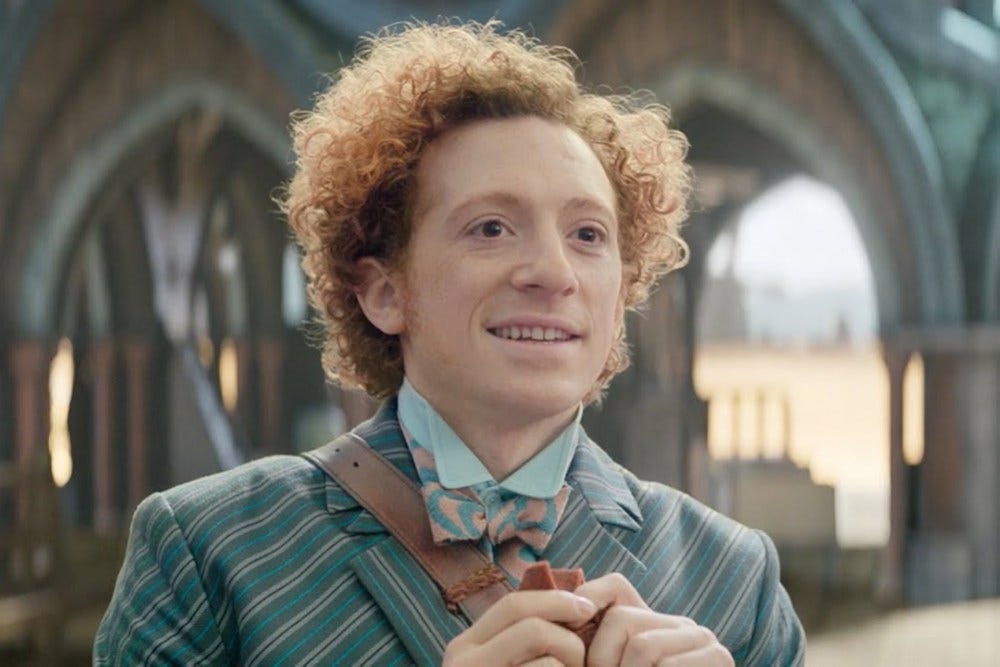
(Pictured Above: Public Enemy #1, Source: Variety)
I know earlier I said Mr. Thropp was the devil, but let’s establish that there are many incarnates of the devil. Boq is also the devil. The worst of the worst.
Ethan Slater is very good in the role, though.
MORRIBLE AND THE WIZARD.
Something I really enjoy about Wicked is how it sort of misdirects you in title. If you know nothing else about Wicked but know about The Wizard of Oz, you think you can expect the story you’re getting… but it flips it on its head, and the truth of the matter is… The Wicked Witch, all along, is Madame Morrible. Not Elphaba. Morrible is the source of every bit of evil in the narrative. You could view The Wizard as her henchman, of sorts. She holds the true power. Also, for the film, I actually really enjoy that they chose to make Morrible a more intimidating presence and not a campy Disney-esque villain. It just makes more sense for the medium of film. You have to be over-the-top on the stage, by the nature of its medium, but that wouldn’t have worked just as well in the film universe. Now… I do think if everyone was so insistent on casting Michelle Yeoh, they should’ve just taken out her singing parts or worked around her admitted lack of vocal abilities. It wouldn’t have been that hard.
Wicked isn’t really canon, so if you try to apply the events of Wicked into the actual narrative of Wizard of Oz… it does get confusing. You just have to watch it and accept The Wizard of Oz retelling bits that are already in the play/film as the canon, not the actual 1939 film. You can try to force it, though, and it gets really funny. Watch The Wizard of Oz before seeing Wicked: For Good and just try to imagine these events happening at the same time as one another. Better yet, try to imagine Morrible existing just down the yellow brick road.
Of course, there are choices made in Wicked that I don’t entirely appreciate. Some jarring blocking choices that weirdly hide the key choreography moments that I would want to appreciate… cinematography/lightning that make the practical, handmade sets look fake… bizarre scene-by-scene editing. Things that sort of undermine the actual craftsmanship on display. Still, though, I could never hate this film. You can tell that everyone involved put so much care into their roles. Cynthia and Ariana were meant to be here. It is divine that they are alive at the same time as one another and had this project offered. They are magic radiating on the screen. I also really appreciate how they adapted the musical to screen, in terms of screenplay. They added depth to both the universe and the character work, which makes the emotional beats hit all the harder, yet also feels so natural. There’s this quote from Jon M. Chu where he defends certain directorial and lighting choices, where he says he wanted Oz to feel like “a real place” and the choices were intentional to ground it, but I actually think the screenplay was already working overtime to find the heart and reality of the universe.
I think I’ve said all I need to say. Which is ironic because I didn’t say much. Perhaps it would’ve made more sense for me to write this AFTER seeing For Good so I could review the entire arc… but I didn’t do that. Perhaps you’ll be hearing from me again very soon with updated thoughts. What I know for sure is, I saw The Wiz in theaters earlier this year for an anniversary screening, and it was life changing. Close us out, Diana!
If I'm way off base please let me, know. I want to talk about Nessarose so bad but like she has no fans it seems like, very few places to discuss this complexed, and nuanced character.
Heavy on the Nessarose defense team (again to an extent, not down with the whole dictatorship mess).
The Thropp sisters DEVASTATE me!
I just feel so deeply about the overall story of Elphaba and Nessarose.
As someone who has an older sister, as well as a younger sibling that has Autism, I feel like I can see the different sides that both Elphaba and Nessarose have when it comes to the story of Wicked, or more so their story within the context of being sisters and how they grew up before they ever stepped foot in Shiz University.
Now trust we all know the path Nessarose finds herself on, and how her story ends.
I just feel like tossing Nessarose into the box of the "bratty, ungrateful, mean younger sister" label is understandable, yet kind of one sided.
The type of sibling relationship that Elphaba and Nessarose have is because if that wicked a-hole of a father and their careless, cheating mother. The foundation that the sisters grew up in, neither of them ever stood a chance. They were going to become the wicked witches regardless.
Elphaba suffered from eldest daughter syndrome yes, but Nessa was seen as perfect and treated like a princess, by her father yet, was rarely seen or heard by anyone really but Elphaba. Then again, there was a codependency that occurred between the two, because (whether she ever truly wanted to admit it or not) Nessa DID rely on Elphaba for a lot, but she also resented Elphaba nor did she ever stick up for her older sister.
So, you have the overall resentment from Nessarose towards Elphaba, Nessarose feeling like everyone is trying to push and pull her every which, way, yet getting treated with this "careful she'll break" attitude, not being seen by the guy she likes etc, and then you have Elphaba who raised one and doesn't know anything but protecting and looking out for her sister.
Elphaba does her best to not take any pent-up resentment and anger towards Nessarose, but Nessarose doesn't do the same. It's sad, no one wins. They were put into these certain roles since each other's births, and they didn't know how to correct, especially on Nessarose's end.